What If Onboarding Investors Didn’t Take Weeks? Benefits of Due Diligence Automation
Last Revised: February 12, 2026At a Glance
Due diligence automation is reshaping investor onboarding by reducing manual work, accelerating compliance reviews, and strengthening auditability. With AI-driven tools, firms can cut costs, reduce regulatory risk, and focus human expertise where it matters most.

Automated due diligence
Teams handling due diligence processes often find themselves buried in paperwork and spreadsheets, sharing updates through long email chains and ad-hoc meetings. By using due diligence automation, though, they can quickly ingest documents, run KYC/AML checks, and flag exceptions automatically. Instead of chasing signatures or reconciling data, compliance professionals focus on reviewing high-risk cases and applying judgment where it matters.
This isn’t just about speed. Automation improves consistency, strengthens auditability, and ensures regulators see a clear, defensible process.
Market trends reinforce this shift. According to Magistral, the global financial due diligence market is projected to grow from $36.07 billion to $63.65 billion over the next decade (CAGR 7.39%).
Let’s look at the key advantages gained by private market firms using automation.
Time Savings and Cost Efficiency
Automating due diligence shortens onboarding timelines that often run into several weeks, compressing them to days by handling document intake, KYC/AML checks, and exception flagging upfront. This speed improves investor experience and lets firms react more quickly to fundraising opportunities.
The efficiency also reduces costs by cutting reliance on manual reviews. Compliance teams can redirect effort toward higher-value activities such as complex risk assessments and investor relationship management. As a result, rigorous checks become cost-effective even for smaller commitments that might otherwise have been deprioritized.
Enhanced Accuracy and Consistency
Manual onboarding is highly prone to errors — from mistyped data to inconsistent application of policies across investors. Automating due diligence reduces this risk by applying consistent rules to identity verification, sanctions screening, and risk scoring. AI tools can also flag anomalies and potential red flags that may not surface in a manual review, helping firms catch issues early.
Equally important is consistency. With automation, every investor is evaluated against the same compliance framework, regardless of jurisdiction or deal team. This standardization reduces bias, ensures fairness, and creates a clear audit trail that regulators and auditors can rely on. The result is lower compliance risk and greater confidence in the integrity of the onboarding process.
Cultural Benefits and Reduced Burnout
Automating investor due diligence also improves team dynamics. By taking repetitive tasks like document collection, screening, and data entry off analysts’ plates, firms reduce burnout and improve retention. Compliance professionals spend more time on higher-value activities such as reviewing complex risk cases and managing investor relationships — the work they find more meaningful.
This shift elevates the compliance function. Instead of being seen as a bottleneck, the team provides more proactive risk management and clearer oversight for senior stakeholders. The result is a more engaged workforce and a compliance process that strengthens the firm’s reputation with both regulators and investors.
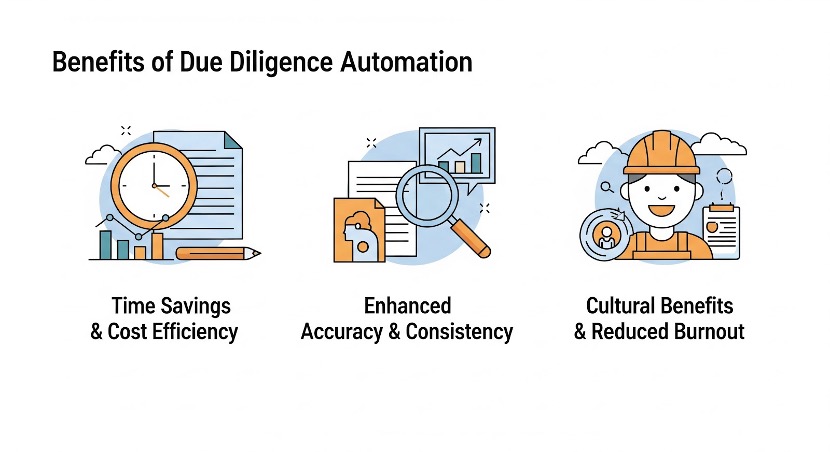
Benefits of due diligence automation
ֿHow Can Firms Successfully Implement Due Diligence Automation?
Adopting due diligence automation requires thoughtful planning and careful execution. Starting small — for example, by automating document intake or sanctions screening — helps teams validate results, build confidence in the system, and scale gradually. Here are some key strategies for a successful implementation.
Data Security and Confidentiality
Investor due diligence involves highly sensitive personal and financial information. Protecting this data is not optional — it is a regulatory obligation. A secure automation platform should provide end-to-end encryption, strict access controls, and full audit trails. Leading firms also expect vendors to operate within a zero-trust security framework and undergo regular penetration testing and compliance audits. Selecting a platform with these safeguards ensures that automation strengthens compliance without introducing new risks.
Establishing Clear Success Metrics
To measure the impact of automation, firms need clear, quantifiable metrics tied to business goals. Common benchmarks include reductions in processing time, fewer manual errors, faster compliance approvals, and improved audit readiness. These success metrics not only demonstrate ROI to stakeholders but also guide phased adoption, ensuring the platform delivers value as scope expands.
Driving Adoption and Change Management
Transitioning from manual workflows to automation requires active change management. Compliance teams may hesitate without clear communication, structured training, and evidence that automation reduces repetitive tasks rather than replacing roles. By showing how automation improves auditability, strengthens oversight, and frees staff to focus on complex exceptions, firms can build trust in the system and accelerate adoption.
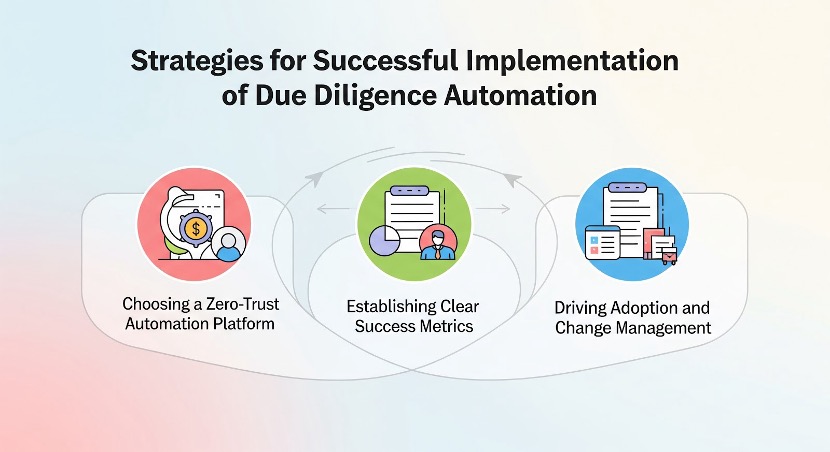
Strategies for Successful Implementation of Due Diligence Automation
Preparing for the Future of Due Diligence: Where to Begin?
Forward-thinking firms are already experimenting with new technologies, training teams, and rethinking their onboarding workflows. Automation doesn’t replace human oversight; it enhances it. By handling routine checks and data validation, intelligent tools free compliance professionals to focus on complex exceptions and higher-risk cases. The future is about empowering teams to act faster, with more confidence, and with stronger auditability.
The Bottom Line
Automating investor due diligence delivers faster onboarding, lower compliance risk, and consistent processes across all investors. Choosing an AI-first platform provides a secure, audit-ready foundation that lets firms scale without adding headcount.
Why Blackbird?
Blackbird offers an AI-first solution tailored to private market firms — covering Due Diligence, KYC, and AML in one seamless platform.
Want to learn more? Book a demo with our team or visit blackbrd.co.
For more insights (or fun KYC memes), follow us on LinkedIn.
About the Author
Linoy Doron is a Content Strategist at Blackbird, where she translates complex fintech and compliance topics into clear, actionable insights. With a strong background in technology, SaaS, and UX, she crafts narratives that connect product value to the real needs of asset managers in the private market.