How Can AI-First Technology Scale UBO Compliance and Ownership Tracing?
Last Revised: February 9, 2026TL;DR
AI-first technology helps asset managers to scale UBO compliance, automate ownership tracing, reduce onboarding friction, and maintain regulator-ready compliance across complex private market structures.
Ultimate Beneficial Owner (UBO) verification has traditionally been viewed as a static regulatory obligation during onboarding. However, this perspective is shifting. As private equity, venture capital, and hedge fund managers navigate increasingly complex investor structures, the integrity of UBO data now directly impacts deal execution, audit readiness, and the overall investor experience.
Today, UBO identification has evolved into a vital form of risk intelligence. Senior compliance, legal, and operations teams require absolute confidence in this data to evaluate institutional LPs and portfolio entities effectively. Investors themselves, on the other hand, expect speed: According to recent research from Fenergo, 74% of asset managers globally lost clients in the past year due to onboarding delays, the highest rate ever recorded.
Our first two posts in the UBO series established the global regulatory landscape and the nuanced challenges of ownership tracing. Now, we dive into the operational reality: How can the right technology turn a historically-tedious process into a strategic advantage for asset managers? Let’s find out.

For modern asset managers, UBO identification has evolved into a vital form of risk intelligence
What Problems Does AI-First Technology Solve in UBO Compliance?
- Manual ownership tracing across jurisdictions
- Inconsistent interpretation of layered structures
- Human error in document-based data extraction
- Slow investor onboarding and re-verification
How Can AI-First Technology Turn UBO Compliance Into a Strategic Advantage?
From automating the “unwrapping” of multi-jurisdictional shell structures to providing real-time visibility into ownership shifts, using the right tools and platforms can significantly improve operational efficiency. It can also streamline internal and external collaboration, and facilitate credibility with LPs and regulators.
Four key technological areas are reshaping how private market firms manage ownership tracing and verification.

The right tools use AI-first technology to unwrap multi-jurisdictional structures and provide real-time visibility
AI for Structural Interpretation and Anomaly Detection
With global AML fines jumping 417% in the first half of 2025 (ComplyAdvantage), the risks hidden within multi-layered structures have outpaced the capacity of manual oversight. AI-driven models solve this by scanning and classifying complex ownership far faster than human review. These models recognize entity types, extract names, and map relationships, from GPs and LPs down to underlying SPVs. Detecting nominee patterns and flagging anomalies would typically require hours of analyst time; but this technology accelerates risk discovery while ensuring tracing remains consistent across offices and jurisdictions.
Automated Document Ingestion and Extraction
Most UBO-related work traditionally relies on numerous certificates of incumbency, shareholder registers, and trust deeds. Modern automation seamlessly ingests uploaded documents and extracts ownership and control data via intelligent field mapping. Then, it harmonizes everything into a structured dataset. This reduces the human error inherent in “copy-paste” compliance and eliminates duplicative effort. Additionally (and crucially), it creates an action-level audit trail, showing exactly where each data point originated.
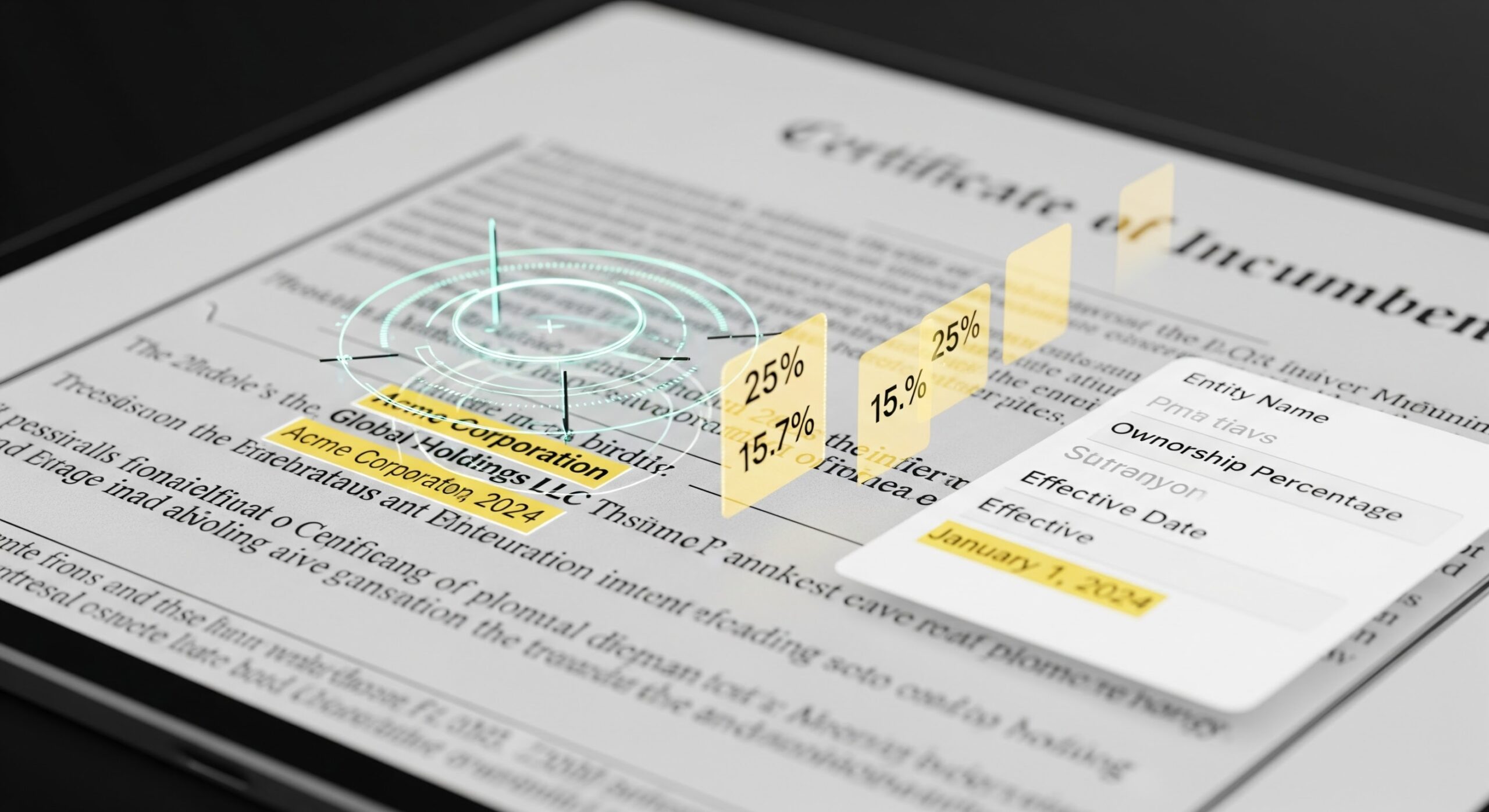
Modern automation extracts relevant ownership and control data via intelligent field mapping
The Network Effect: Reusable Digital Identity
Perhaps the most significant strategic shift is the move toward “onboard once, reuse everywhere.” Through a KYC Passport, investors can maintain a single, verified profile of their UBO data. This profile can then be shared with new funds or entities with one click. This turns a historically high-friction process into a value-add for the investor, and drastically reduces onboarding timelines from weeks to hours.
Integrated, End-to-End Orchestration
When data, documents, and screening results sit in fragmented systems, teams spend more time reconciling info than assessing risk. Integrated platforms unify document storage, UBO extraction, and live AML/PEP screening in one secure workspace. By syncing directly with existing CRMs and fund administration systems through APIs, these platforms eliminate duplicate data entry and give senior management a holistic view of the full compliance stack in real time.
The Bottom Line: Technology as the Catalyst for UBO Excellence
For modern asset managers, UBO capability is now a core component of operational identity. Moving away from manual tracing signals the maturity that high-standard LPs demand. In fact, research shows that 87% of institutional investors have reconsidered fund commitments due to compliance concerns (CSC). By using technology to demonstrate consistent, well-documented tracing, firms build the “compliance integrity” necessary to facilitate smoother closings and prevent late-stage deal friction.

AI-first technology ensures you remain a compliant, efficient, and transparent partner for your investors
The business upside is quantifiable: platforms using AI-first technology help scale UBO compliance and capacity without adding headcount. Automation identifies risks early, preventing the massive costs and reputational damage of unwinding a partnership after capital deployment. Ultimately, clear UBO workflows reduce the burden of regulatory exams by maintaining a real-time, regulator-ready record of every ownership decision.
By integrating automated extraction, reusable digital identities, and orchestrated workflows, firms can turn a clerical bottleneck into a strategic advantage. In today’s high-stakes private market, the right technology ensures you remain the most efficient, transparent, and trusted partner for your investors.
Why Blackbird?
Blackbird is used by private market firms managing complex multi-entity investor structures across multiple jurisdictions. By unifying UBO tracing, AML screening, and due diligence into one seamless platform, we enable asset managers to accelerate onboarding from weeks to hours without adding headcount.
Want to see our UBO mapping in action? Book a demo with our team.
For more insights (and the occasional KYC meme), follow us on LinkedIn.
About the Author
Linoy Doron is a Content Strategist at Blackbird, specializing in fintech, compliance automation, and private market operations. She works closely with compliance and product teams to translate regulatory complexity into scalable technology narratives for global asset managers across private equity, venture capital, and hedge funds.