Must-Have Components for KYC Automation: What Should Private Market Firms Look For?
Last Revised: February 9, 2026At a Glance
Effective KYC automation in private markets requires more than flashy UX — it needs deep capabilities for entity onboarding, risk screening, and integration with existing platforms. Here are the must-have components for KYC automation.
Not every KYC automation solution is created equal. Some look impressive in demos but lack the capabilities needed for institutional, multi-jurisdictional investor onboarding — with over 40% of firms using AI tools in compliance still relying on manual intervention in more than half of their onboarding cases, according to Authbridge.
In private equity, venture capital, and hedge funds, KYC must handle entity-heavy structures, complex ownership layers, and jurisdiction-specific regulatory obligations. This section outlines the must-have components for KYC automation — those that drive real results in private markets operations.

KYC automation arsenal: what do private market firms need?
Identity Verification: The Foundation of KYC Automation
Robust identity verification forms the bedrock of any successful KYC process, with synthetic identity fraud having risen by nearly 18% in 2024. In private markets, this applies to both individual investors and to the ultimate beneficial owners (UBOs) and controlling persons within entities. It is the first line of defense against fraud and a critical step in meeting regulatory obligations.
- Document Verification: Verification of government-issued identification (e.g., passports, national ID cards, driver’s licenses) for individuals. Advanced systems can use OCR and image analysis to detect alterations or expired documents. Where jurisdiction or fund policy requires, certified or notarized copies can be captured and logged through the same workflow.
- Biometric Matching (Where Permitted): Some GPs and administrators use facial recognition to compare an investor’s selfie with their ID photo to speed onboarding for individuals. This is typically supplementary to documentary verification.
- Liveness Detection: Helps confirm that the biometric submission comes from a live person rather than a spoof or static image. Used selectively, particularly for higher-risk profiles or remote-only onboarding.
These tools can improve speed and accuracy for individual-level verification, but in private markets, they are only the first step of a broader process.
Enhanced Due Diligence Through Automated Screening
Once identities and entity ownership are confirmed, the next step is to assess investor risk through screening. Automated watchlist screening accelerates this process significantly, helping to identify potential red flags early by checking customer data against various databases.
- Sanctions Lists: Checks against OFAC, UN, EU, and other jurisdiction-specific lists.
- Politically Exposed Persons (PEP) Databases: Identification of individuals in prominent public roles, as well as their close associates and family members.
- Adverse Media Screening: Automated scanning for credible negative news or public records involving the investor, their entities, or UBOs.
Automated systems can complete the initial screening in seconds — with automated case creation for any potential matches, so compliance teams can focus on resolution rather than data gathering.
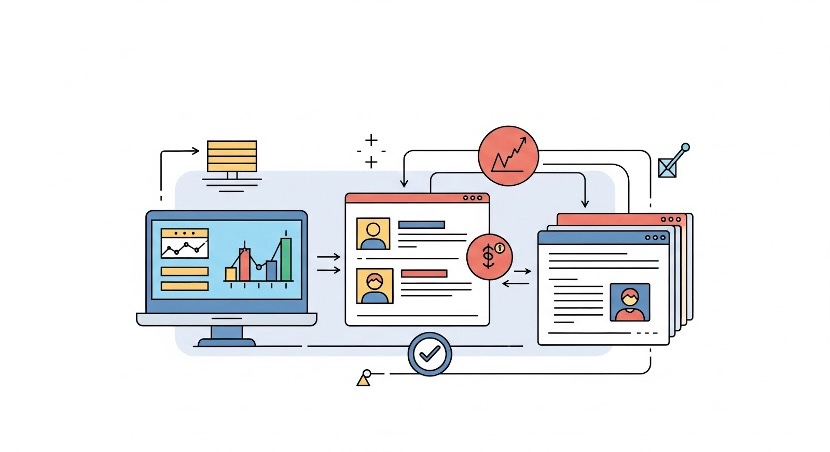
Automated screening processes
AI-Powered Risk Scoring for Private Markets
Instead of binary “pass/fail” checks, AI-powered risk scoring provides a more nuanced and comprehensive approach, analyzing a broader range of data points — from jurisdictional ratings and PEP status to structure complexity and documentation quality.
Key elements include:
- Jurisdiction Risk: Country of domicile/incorporation and relevant AML risk ratings.
- Investor Type: Individual, corporate, trust, foundation, SPV, etc.
- Ownership Complexity: Number of ownership layers, cross-border structures, nominee arrangements.
- PEP Status: Presence of politically exposed persons among UBOs or controlling persons.
- Source of Wealth / Source of Funds: Clarity and credibility of documentation provided.
This information generates a risk score, giving a more complete picture of each customer’s potential risk. Financial institutions can then tailor their compliance actions, with higher scores triggering enhanced due diligence, while lower-risk profiles can move through standard approval paths more quickly.
Integration With Existing Infrastructure: The Key to Scalability
Selecting the right components is only the first step. Did you know that according to Authbridge, 68% of customers who abandoned onboarding processes cite “repetitive documentation” and “inconsistent communication” as key reasons?
In private markets, successful KYC automation also depends on seamless integration with existing platforms and stakeholders involved in the fund lifecycle. This integration creates a centralized, accessible data hub.
- Fund Administrator Platforms: To synchronize investor data, KYC status, and document storage between GP and administrator.
- Investor Portals: To collect subscription documentation, ID/KYC materials, and facilitate secure investor communications.
- CRM Systems: Such as Salesforce or DealCloud, to maintain a single investor record across fundraising, onboarding, and relationship management.
- Secure Document Management Systems: To provide centralized, permission-controlled access to verified documents for compliance, operations, and audit teams.
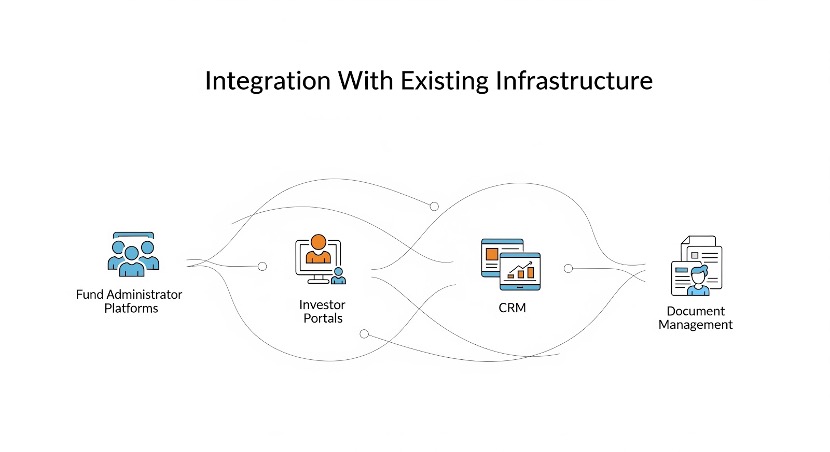
Integrations with existing KYC infrastructure
Integration across these systems creates a unified ecosystem of investor information and compliance status, reduces duplicate data entry, and supports regulatory alignment in multiple jurisdictions — while maintaining clear ownership of regulatory decision-making.
The Bottom Line: What Are the Must-Have Components for KYC Automation?
In private markets, effective KYC automation must handle both the individual and entity aspects of onboarding, incorporate risk-based screening, and integrate tightly with administrator and GP systems. Speed matters, but so does auditability, jurisdictional compliance, and the ability to handle manual exceptions efficiently.
Why Blackbird?
Blackbird offers an AI-first solution tailored to private market firms — covering KYC, AML, and Due Diligence in one seamless platform. Our built-in automation means faster onboarding and compliance, without the added headcount.
Want to learn more? Visit blackbrd.co or book a demo with our team.
For more insights (or fun KYC memes), follow us on LinkedIn.
About the Author
Linoy Doron is a Content Strategist at Blackbird, where she translates complex fintech and compliance topics into clear, actionable insights. With a strong background in technology, SaaS, and UX, she crafts narratives that connect product value to the real needs of asset managers in the private market.